Due to F1 road closures, the Gallery carpark is open 7–9 Oct from 7–10am. The carpark will be closed from 9 Oct, 10am and will reopen on 13 Oct, 7am. Click here for more details.
The UOB Southeast Asia Gallery is temporarily closed and will reopen in late 2027. In the meantime, works from the National Collection remain exhibited across the Gallery.
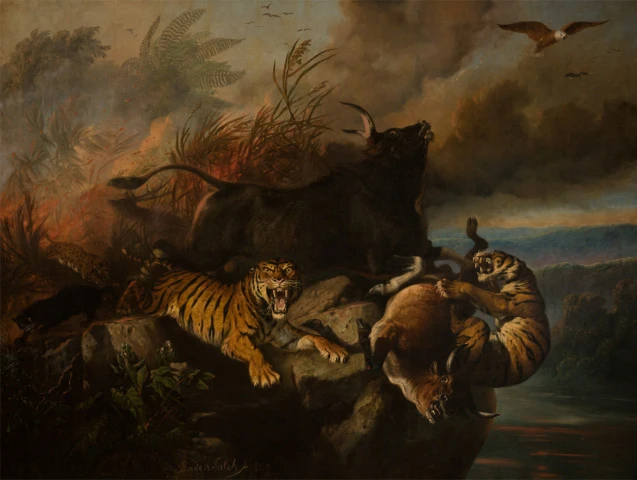
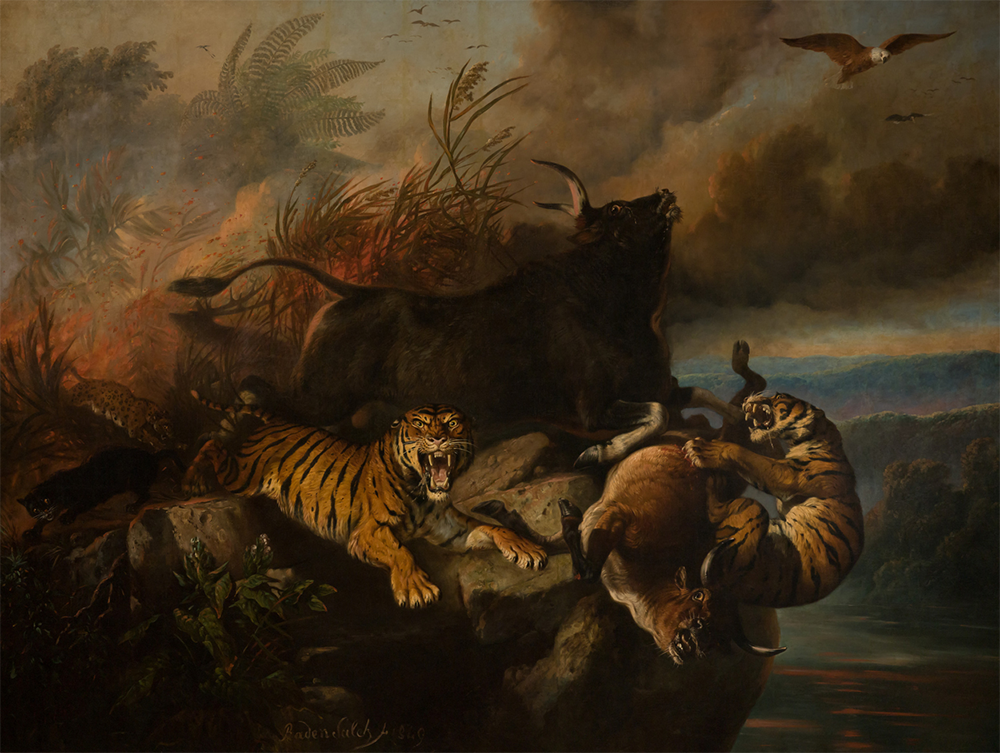
Raden Salah. Boschbrand (Forest Fire). 1849. Oil on canvas, 300 x 396 cm. Collection of National Gallery Singapore. This work has been adopted by Yong Hon Kong Foundation.
Presented in Singapore for the very first time, this is the largest travelling exhibition of artist He Xiangning’s (何香凝) (b. 1878, China; d. 1972, China) artworks from the He Xiangning Art Museum (Shenzhen, China).
A leading ink artist and a prominent political figure, He Xiangning played an important role in the development of modern China. One of the earliest Chinese women to pursue art studies in Japan, she was closely connected to the Lingnan school. Works such as Lion (1914), along with her notable fundraising art exhibitions in Singapore and Manila in 1929, demonstrate how she fused political and social ideals through her art.
Featuring over 50 ink works and extensive archival materials, the exhibition reconnects He Xiangning's artistic activities and significance to Chinese modern art, Singapore, Penang and the region’s art history.
When: 1 Apr – 23 Aug 2026
Suitable For: All
Where: City Hall Wing, Level 4, Wu Guanzhong Gallery
Ticket Information: General Admission ticket required, free for locals.
For access to our ticketed spaces and exhibitions, an admission ticket is required.
Free admission to all areas for Gallery insiders, children aged 6 and below, students and teachers currently based in Singapore, persons with disabilities (PWD) and their caregiver.
General Admission Ticket
A General Admission ticket grants one-time entry to selected exhibitions and tours, valid for 180 days from the purchase date.
Concession rates of $5 off apply to all ticket types for children aged 7–12, seniors aged 60 and above, full-time National Servicemen (excluding foreign personnel), and overseas students and teachers from qualifying institutions.
General Admission Ticket
A General Admission ticket grants one-time entry to selected exhibitions and tours, valid for 180 days from the purchase date.
Concession rate of $5 off apply to all ticket type applicable to children aged 7–12, seniors aged 60 and above, overseas students & teachers and full-time National Servicemen (NSF), excluding foreign personnel.
Before you visit
Some parts of the Gallery may be cold, so please bring along a jacket just in case.
More information about accessibility and etiquette at the Gallery can be found at Visitor Information.
Audio tours for selected artworks are also available and can be accessed by scanning the QR codes on the respective artwork labels.
From powerful depictions of lions to evocative landscapes, this exhibition brings together paintings, calligraphy, poetry, and archival materials to explore He Xiangning’s artistic world.
Across her works, recurring motifs such as lions, pine trees, and winter scenes reflect ideas of resilience, solidarity, and moral conviction shaped by a rapidly changing era. Archival materials also offer a glimpse into her wide artistic and social networks across China and Southeast Asia.
Organised into four chronological sections, the exhibition follows the evolution of her art and the historical moments that defined it. Come discover a practice shaped as much by conviction as by craft.
Featured artworks
Lion
He Xiangning
1914. Ink and colour on silk, 63 × 49 cm. Collection of He Xiangning Art Museum.
Lion
1914. Ink and colour on silk, 63 × 49 cm. Collection of He Xiangning Art Museum.
Tiger
He Xiangning
1910. Ink and colour on silk, 26 × 30 cm. Collection of He Xiangning Art Museum.
Tiger
1910. Ink and colour on silk, 26 × 30 cm. Collection of He Xiangning Art Museum.
Pine and Chrysanthemums.
He Xiangning
1931. Ink and colour on paper, 173 × 273 cm. Collection of He Xiangning Art Museum.
Pine and Chrysanthemums.
1931. Ink and colour on paper, 173 × 273 cm. Collection of He Xiangning Art Museum.
Pine, Bamboo and Plum Blossoms
He Xiangning, Jing Hengyi, Chen Shuren, Yu Youren
1928. Ink on paper, 137 × 34 cm. Collection of He Xiangning Art Museum.
Pine, Bamboo and Plum Blossoms
1928. Ink on paper, 137 × 34 cm. Collection of He Xiangning Art Museum.
Pine, Bamboo and Plum Blossoms
He Xiangning, Jing Hengyi, Chen Shuren, Yu Youren
1936. Ink and colour on paper, 143 × 47.4 cm. Collection of He Xiangning Art Museum.
Pine, Bamboo and Plum Blossoms
1936. Ink and colour on paper, 143 × 47.4 cm. Collection of He Xiangning Art Museum.
Plum Blossoms, Rock and Peonies
He Xiangning
c. 1920s. Ink and colour on paper, 146 × 45 cm. Collection of He Xiangning Art Museum.
Plum Blossoms, Rock and Peonies
c. 1920s. Ink and colour on paper, 146 × 45 cm. Collection of He Xiangning Art Museum.
A Moonlit Scene
He Xiangning
c. 1920s. Ink and colour on paper, 80 × 38 cm. Collection of He Xiangning Art Museum.
A Moonlit Scene
c. 1920s. Ink and colour on paper, 80 × 38 cm. Collection of He Xiangning Art Museum.
Press On. For Mr Khoo Seok Wan’s keepsake
He Xiangning
Republican year 18, October. From Album of Treasured Ink by Lin Zexu. Ink on paper, c. late 18th to early 20th century. Collection of Ong Cheng Kian and family, descendants of Khoo Seok Wan.
Press On. For Mr Khoo Seok Wan’s keepsake
Republican year 18, October. From Album of Treasured Ink by Lin Zexu. Ink on paper, c. late 18th to early 20th century. Collection of Ong Cheng Kian and family, descendants of Khoo Seok Wan.
Green Plum Blossoms
He Xiangning
1943. Ink and colour on paper, 57 × 36 cm. Collection of He Xiangning Art Museum.
Green Plum Blossoms
1943. Ink and colour on paper, 57 × 36 cm. Collection of He Xiangning Art Museum.
The Tall Pine Stands at the Sea’s Edge
He Xiangning
1960. Ink and colour on paper, 135 × 140 cm. Collection of He Xiangning Art Museum.
The Tall Pine Stands at the Sea’s Edge
1960. Ink and colour on paper, 135 × 140 cm. Collection of He Xiangning Art Museum.
Appreciating the Snow
He Xiangning, Fu Baoshi
1962. Ink and colour on paper, 132 × 37 cm. Collection of He Xiangning Art Museum.
Appreciating the Snow
1962. Ink and colour on paper, 132 × 37 cm. Collection of He Xiangning Art Museum.
He Xiangning (1878–1972) was a leading figure in modern China, recognised as a social activist and artist. One of the earliest members of the Tongmenghui, she was also among the earliest Chinese women artists to study overseas. Through her art, He Xiangning engaged in socio-political activities and advocated for women’s rights. Plum blossoms, lions and landscapes often feature in her work. While they reflect her personal convictions, resilience and hopes for national renewal, it also offers insight into the transformation of Chinese painting from inherited traditions to modern expression.
Image Credit: He Xiangning painting for a charity exhibition, 1931 1931年,正在为慈善展览作画的何香凝
He Xiangning was a leading figure in modern China, recognised as a social activist and artist. A member of the Tongmenghui, she was among the earliest Chinese women artists to study overseas, and through sustained practice developed a distinctive painting style. Beyond personal enjoyment, she used art to engage in social and political causes, advocating for women's rights. Held in conjunction with He Xiangning: Ink & Intent, this lecture by scholar Hua Tianxue traces her artistic career, analyses the symbolic significance of her major works, and situates her contributions within the broader cultural landscape of her time.
Explore other exhibitions
Exhibition
Fear No Power: Women Imagining Otherwise
Fear No Power: Women Imagining Otherwise highlights the lives and practices of five artists from Southeast Asia for whom art, life, kinship and community are inseparable. Featuring Imelda Cajipe-Endaya (Philippines), Nirmala Dutt (Malaysia), Amanda Heng (Singapore), Dolorosa Sinaga (Indonesia), and Phaptawan Suwannakudt (Thailand), the exhibition honours their multi-faceted roles—not only as artists, but also as educators, writers or community organisers.
Exhibition
Passion is Volcanic: Desire in Southeast Asian Art (R18)
Passion is Volcanic: Desire in Southeast Asian Art explores how desire, eroticism and the body have shaped artistic practices and cultural discourses in the Southeast Asia. Featuring rarely seen artworks from the National Collection alongside key regional loans, the exhibition embraces the power and presence of desire in art and life. Discover bold, provocative expressions that blur the boundaries we keep between the private and public, the intimate and sublime, soft pleasures and hard politics.
Exhibition
Singapore Stories: Pathways and Detours in Art
The newly revamped DBS Singapore Gallery exhibition presents a layered, ever-changing story of Singapore’s art history. Explore the unique pathways and detours of artists, and see their iconic artworks from the 19th century to present.
13
This website uses cookies to ensure you get the best experience. View our privacy policy